Researchers burn a model scroll to help find readable Herculaneum papyri
To learn how to read scrolls charred by Mount Vesuvius nearly 2,000 years ago, a team led by researchers in Berkeley, California, made and burned a scroll of their own. Their study, published in PLOS ONE and announced by UC Berkeley on September 18, 2026, suggests that scrolls written with lead-bearing ink could be much easier to read with X-rays, and proposes searching for lead to decide which of the Herculaneum scrolls to study first.
The paper is titled "A model carbonized papyrus scroll opens a novel path to identifying readable scrolls of the Herculaneum Library."
The problem with carbon ink
The eruption of Vesuvius in 79 CE carbonized a library of papyrus scrolls in the Roman town of Herculaneum. About 1,800 scrolls and scroll fragments survive in collections in Italy, France and England, according to UC Berkeley. Because most were written in carbon-based ink on what is now carbonized papyrus, the text is hard to distinguish in scans.
"They're having problems reading a lot of them because of the low contrast of carbon ink on carbon paper," said lead researcher Douglas Seiler, a Berkeley SETI affiliate who funded the project himself.
Making a scroll to burn
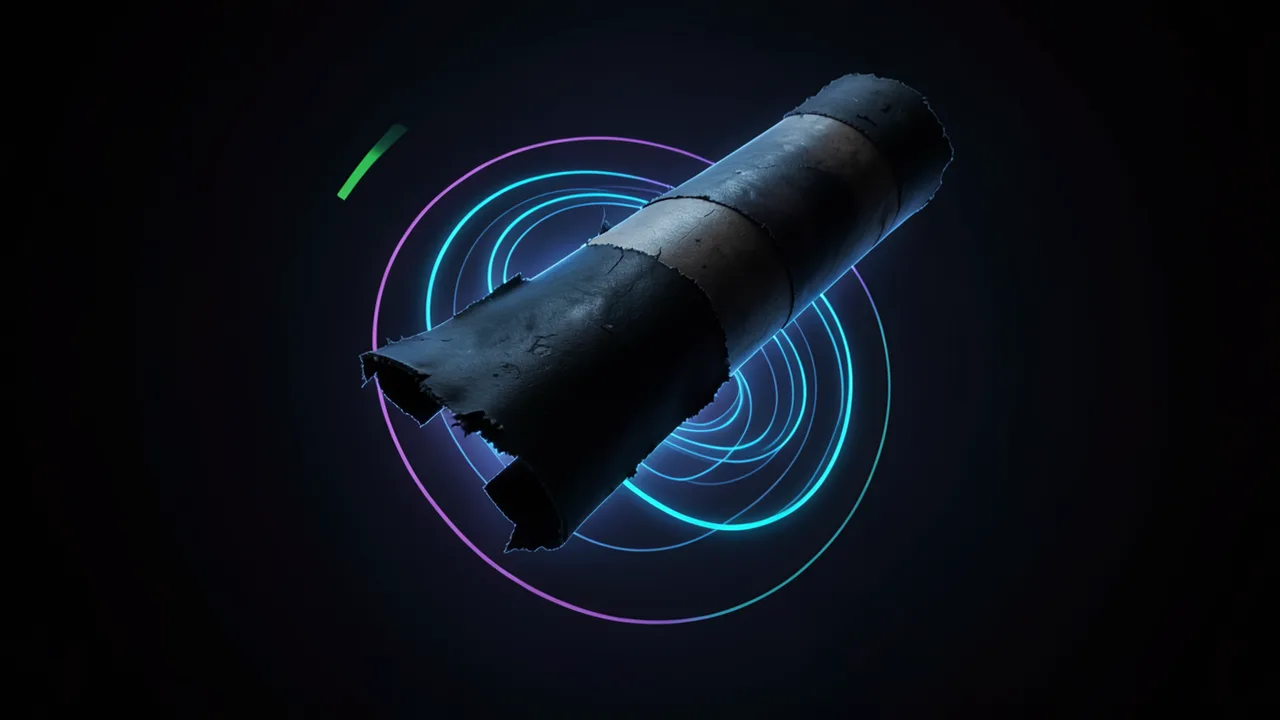
The team obtained papyrus and reed pens from Egypt and traditional lampblack ink from Japan, and hired high school students to write out passages from Star Wars, the Bible and the 1960s television show The Outer Limits. Retired Berkeley chemists David Kreimer and Elena Kreimer mixed measured amounts of lead nitrate into the ink at different concentrations. The papyrus was rolled, sealed in a container with little oxygen and carbonized in a high-temperature furnace.
Physicist Jake LaManna of the NIST Center for Neutron Research scanned the charred scroll with X-ray computed tomography, and software developed by Michael Cyrus Daugherty, adapted from methods used to unroll the layers of lithium-ion batteries, unrolled it virtually.
Lead lights up
According to UC Berkeley, lead absorbs up to 25 times more X-rays than carbonized papyrus, and ink containing as little as 25 micrograms of lead per square centimeter could be detected. The researchers also showed that inexpensive handheld X-ray fluorescence scanners could be used for initial screening.
"With lead in the ink, you would get a huge friggin' signature, so you really need to be looking for scrolls with lead in them," Seiler said. He called the approach "the Holy Grail."
Leah Packard-Grams, a UC Berkeley archaeology graduate student who consulted on the project, said: "If we know that the Herculaneum papyri have lead in them—some of them do, some of them don't—then when they take the CT scan, they can scan it with a sensitivity for the element lead and we can see where the ink is."
Building on the Vesuvius Challenge
The work follows the Vesuvius Challenge, launched in 2023 by Brent Seales of the University of Kentucky with a $700,000 grand prize, which led in 2024 to the recovery of 15 columns of text from one scroll.
"The value in this project is practically unquantifiable. The stakes are the largest in the history of Greek literature," Packard-Grams said.
Why it matters
The Herculaneum library is one of the few collections of books to survive directly from the classical world, and most of it remains unread. Scanning each scroll in detail is slow and expensive. A screening method that flags scrolls whose ink contains lead could help researchers prioritize the ones most likely to yield readable text.
Sources
- Phys.org / UC Berkeley, "To read 2,000-year-old burned scrolls, scientists burn their own"
- ScienceDaily / UC Berkeley, "Scientists burned their own scrolls to unlock a 2,000-year-old mystery"
This article was drafted with AI assistance and checked against the sources above. Company claims are reported as claims. Cover image is AI-generated.